
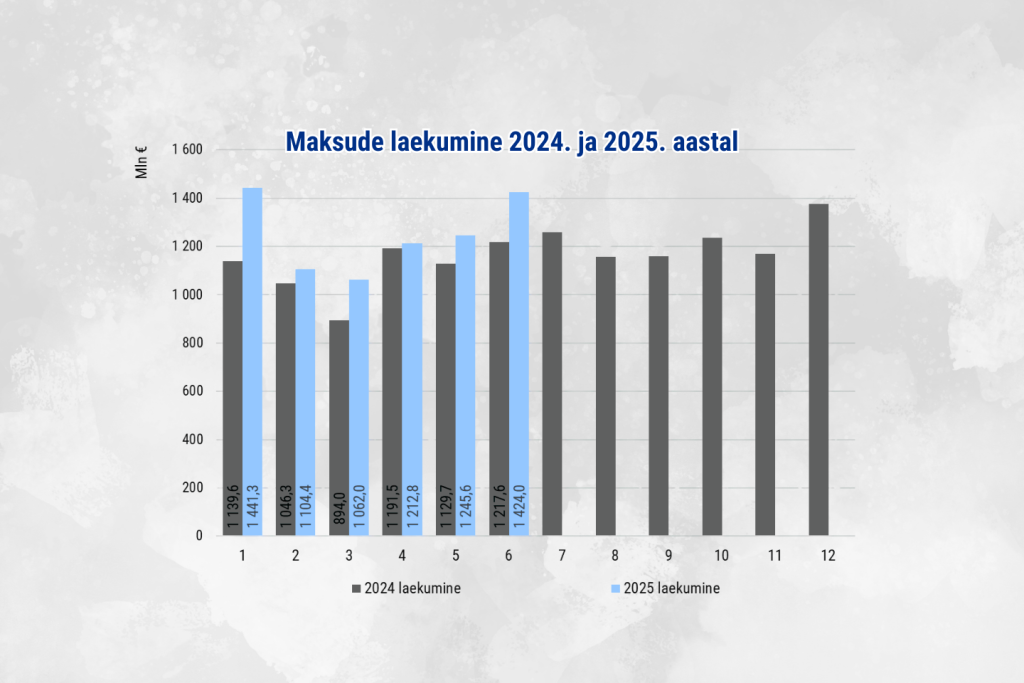
According to Raili Roosimaa, ETCB’s Deputy Director General for Taxes, there are several factors behind the increased receipts. “The main factors are an increase in salary payments, changes in tax rates and decrease in incentives for natural persons,” Roosimaa explained. She also emphasised that voluntary tax compliance is very strong in Estonia, with nearly 90% of people and companies paying their taxes on time.
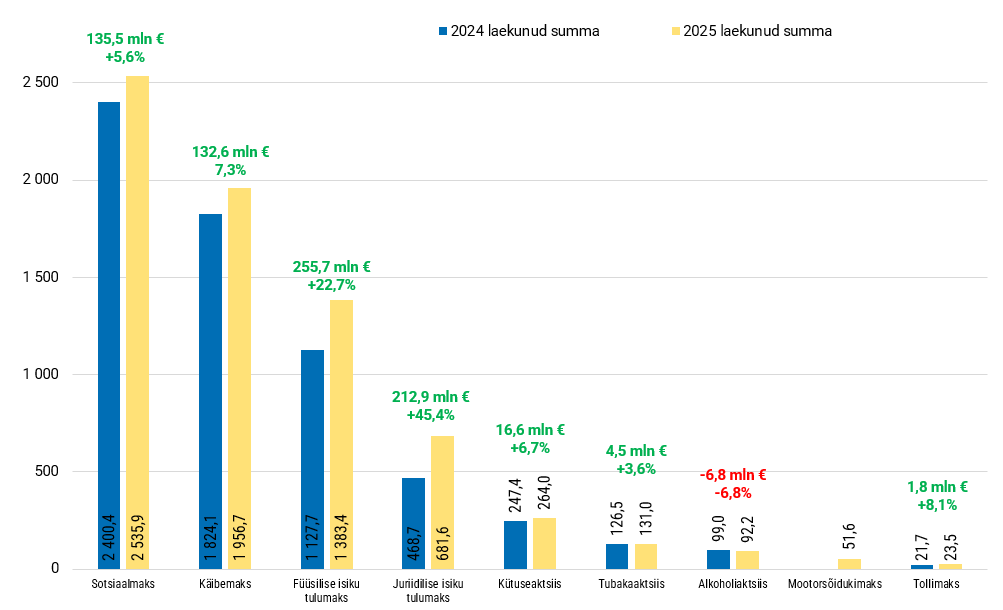
The biggest leap has occurred in the income tax of natural persons, the receipts of which increased by 256 million euros over the year. The main reasons for this are the increase in the income tax rate and the elimination of several tax incentives, which is why less income tax was refunded this year than last year. Corporate income tax receipts also increased by 213 million euros, as more dividends than usual were paid in December before the tax rate increase in January 2025. "Dividends were paid out in December but were declared in January. Therefore, the dividend payments are reflected in the receipts of January," Roosimaa explained.
Social tax receipts increased by 5.6% in the first half of the year, i.e. by a total of 136 million euros more than in the same period a year earlier. This was mainly influenced by the 5.4% increase in salary payments. VAT receipts increased by 7.3% or 133 million euros compared to the first half of 2024. The increase in VAT receipts is due, among other things, to price increases and significantly higher receipts in June before the increase in the VAT rate.
The receipts of excise duties were mostly on an upward trend as well. The only decrease occurred in the receipt of excise duty on alcohol, as at the end of last year, before the increase in excise duty, goods were stockpiled in warehouses. The decrease was 7 million euros or 6.8%.
As at 1 July 2025, tax arrears amounted to 416 million euros. Compared to the first six months of last year, the overall arrears have increased mainly due to social tax, special cases’ income tax and motor vehicle tax arrears. “The amount of tax arrears is constantly changing, depending, among other things, on the declarations submitted, tax proceedings and receipt of payments. As a result, both sharp increases and decreases may occur during the year. However, a more detailed overview can be found in the summary made by calendar year, which shows a longer-term trend", Roosimaa said.
The number of debtors who are natural persons has been affected the most by motor vehicle tax, which entered into force this year, and to a lesser extent by land tax, the payment due dates of which were in the first half of the year. On 1 July 2025, there were approximately 31 000 natural persons whose debt arose or increased in the first half of the year. The number of debtors who are legal persons increased by 2000 during the same period. “However, the overall tax discipline has remained good, as the share of claims paid on time remains close to 90% for both natural and legal persons, and the deferral of tax arrears has also decreased in the first half of the year compared to the past,” Roosimaa commented.
According to Roosimaa, it is to a large extent the automated and convenient e-services environment that lies behind the strong tax compliance, as it makes honest tax behaviour easy. “Our goal is that the payment of taxes is not a complicated or burdensome extra work, but an ordinary part of everyday economic activities. We work hard on it every day," she said.
Information on tax receipts can be found on the website of the Tax and Customs Board.

